
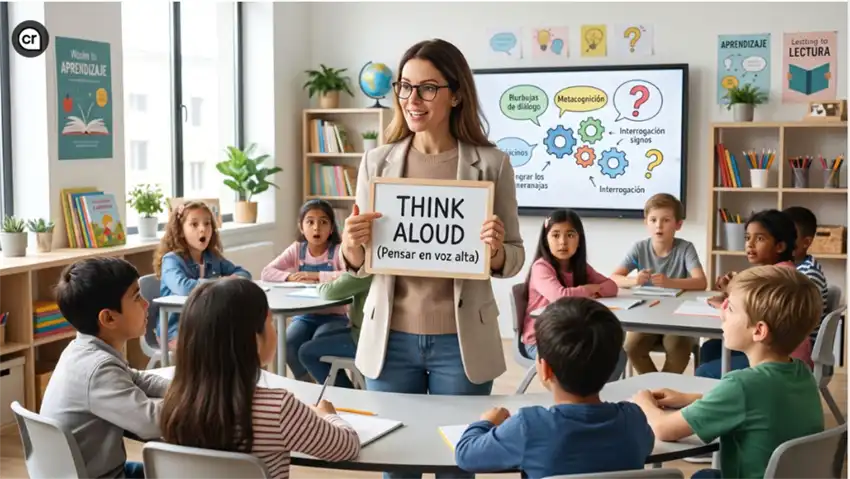
Thinking Aloud: Making the Invisible Visible. Grounded in the Science of Reading and the insights of Lorena Canet Juric, Think-Alouds serve as one of the most powerful metacognitive modeling tools in education.
When a teacher reads aloud and shares their internal thoughts in real time:
✶It’s not a rigid formula: It demonstrates how to approach text rather than giving static rules.
✶It makes the process audible: It lays out doubts, hypotheses, re-readings, and self-corrections as they unfold.
✶It normalizes non-linear thinking: It shows students that deep comprehension is an active, self-regulated process.
The true value of this practice is not teaching students what to do, but making visible how thought is constructed and regulated.
Do you incorporate think-aloud modeling in your teaching or learning environments? I’d love to hear your thoughts below!
Basado en la Ciencia de la Lectura y los aportes de Lorena Canet Juric, el Pensar en voz alta es una de las estrategias de modelado metacognitivo más potentes en el aula.
Cuando una docente lee y comparte su pensamiento en tiempo real:
✶No enseña una receta fija: Muestra cómo abordar la lectura en lugar de dar instrucciones rígidas.
✶Hace audible el proceso real: Pone sobre la mesa las dudas, hipótesis, relecturas y correcciones a medida que ocurren.
✶Normaliza la no-linealidad: Enseña que comprender no es automático, sino un proceso activo y autorregulado.
✶El verdadero valor de esta práctica no es enseñar qué hacer, sino visibilizar cómo se construye y regula el propio pensamiento.
¿Utilizan el modelado de pensamiento en voz alta en sus aulas o espacios de aprendizaje? Los leo en comentarios.